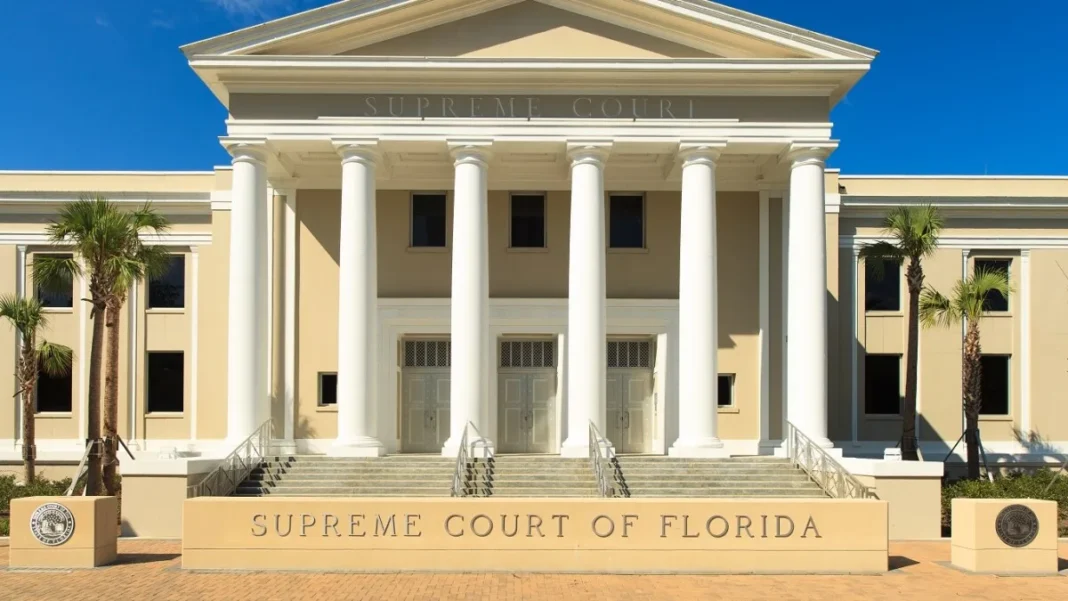

TALLAHASSEE, Fla. — Attorneys representing the Florida House are asking the Florida Supreme Court to consider throwing out the state’s Fair Districts Amendment entirely, a move that could dramatically alter how congressional and legislative districts are drawn in Florida.
The argument emerged in a court filing tied to an ongoing legal battle over Florida’s congressional map, which was redrawn in 2022 under the direction of Gov. Ron DeSantis.
House attorneys contend that portions of the voter-approved constitutional amendment conflict with recent federal court decisions governing the use of race in redistricting.
“The Fair Districts Amendment’s racial classifications treat people differently based on race,” attorneys for the House argued in filings submitted to the Florida Supreme Court.
The challenge stems from litigation brought by voting rights organizations seeking to block Florida’s current congressional map ahead of the 2026 Midterm Elections.
What Is the Fair Districts Amendment?
Florida voters approved the Fair Districts Amendment in 2010 to establish standards for drawing congressional and legislative districts.
The amendment prohibits districts from being drawn to favor or disfavor political parties and requires mapmakers to avoid diminishing minority communities’ ability to elect candidates of their choice.
Supporters have long viewed the amendment as one of Florida’s strongest protections against partisan gerrymandering.
House Says Amendment Conflicts With Federal Law
House attorneys argue that recent legal developments, including the U.S. Supreme Court’s decision in the Louisiana v. Callais case, have raised constitutional questions about provisions requiring consideration of race during the redistricting process.
According to the House filing, those provisions cannot be separated from the rest of the amendment, meaning the entire measure could be vulnerable if the court determines certain sections are unconstitutional.
If accepted by the Florida Supreme Court, the argument could have consequences beyond congressional districts.
The decision could potentially affect future state House and Senate maps and open the door to additional redistricting efforts before the next census.
Voting Rights Groups Push Back
Attorneys representing voting rights organizations strongly oppose the House’s position.
Plaintiffs argue that no court has ruled the Fair Districts Amendment unconstitutional and note that Florida’s current congressional map has remained in place for multiple election cycles.
They also contend that the state is attempting to use recent court decisions to undermine protections approved directly by Florida voters.
The groups maintain that questions about the amendment’s future should not be used to justify keeping disputed district lines in place through another election cycle.
High Stakes for Florida Politics
The legal battle arrives as Florida continues to grow in national political importance and remains one of the country’s largest states.
Any ruling affecting the Fair Districts Amendment could influence how political boundaries are drawn for years to come and shape the balance of political power in Tallahassee and Washington.
The Florida Supreme Court has not yet issued a decision on the request.
Why It Matters
The Fair Districts Amendment has governed redistricting in Florida for more than a decade.
If the Florida Supreme Court agrees with House attorneys, lawmakers could gain significantly more flexibility in drawing political boundaries. If the amendment remains intact, Florida’s current redistricting standards would continue to guide future maps and election disputes.