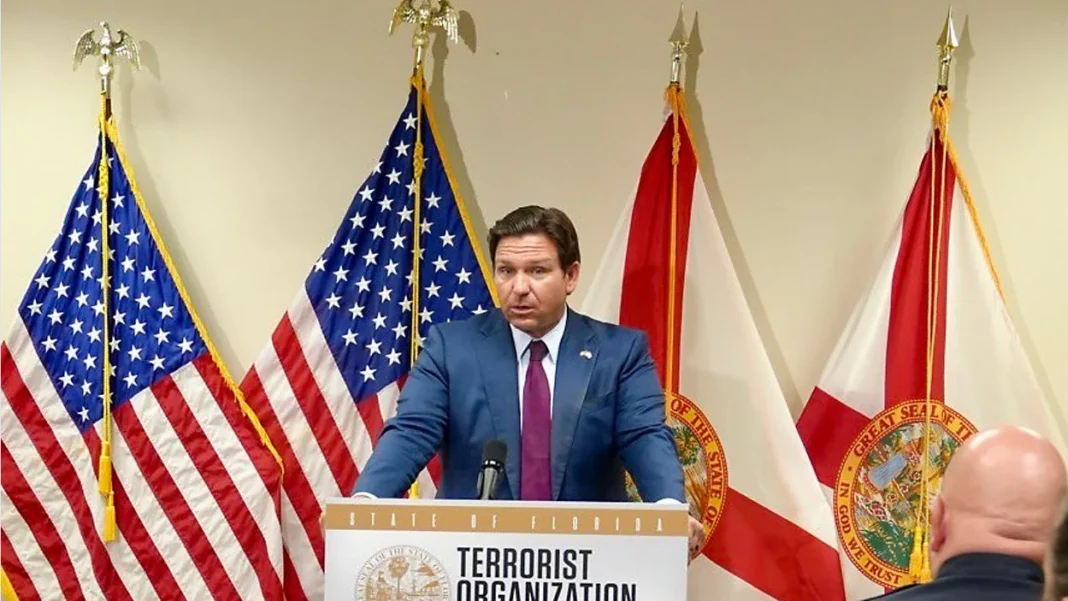

Gov. Ron DeSantis announced Wednesday that Florida is moving to designate CAIR Florida, the Muslim Brotherhood, and Antifa as terrorist organizations under a new state law that took effect July 1, marking one of the first major uses of expanded authority granted to state officials this year.
Speaking during a news conference in Tampa, DeSantis said the Florida Department of Law Enforcement (FDLE) has formally recommended the designations under House Bill 1471, legislation signed into law in March that authorizes Florida to identify domestic and foreign terrorist organizations under state law.
The recommendation now moves to the Governor and Florida Cabinet, who must approve or reject the designation within seven days after receiving FDLE’s written recommendation.
“We did need to have more of a legal structure to be able to add teeth to these designations,” DeSantis said.
The governor also said FDLE has recommended designating more than 90 foreign organizations, including international drug cartels and transnational criminal organizations.
New law expands Florida’s authority
House Bill 1471 gives the FDLE commissioner authority to recommend organizations for designation if evidence shows they engage in terrorist activity as defined under Florida law, are based in Florida when applicable, and pose an ongoing threat to Florida or the United States.
The law also prohibits state agencies, local governments, public schools, colleges and universities from providing taxpayer funding, contracts or public resources to designated organizations.
Individuals who knowingly provide material support to designated organizations may also face criminal penalties under certain circumstances.
Gov. DeSantis said the law strengthens Florida’s ability to respond to organizations state officials believe threaten public safety.
Follows earlier legal battle
The announcement follows an earlier executive order issued by DeSantis in December that attempted to designate CAIR Florida and the Muslim Brotherhood as terrorist organizations.
That action was challenged in federal court by CAIR Florida.
In March, U.S. District Judge Mark Walker issued a temporary injunction preventing enforcement of the executive order while litigation continues.
The DeSantis administration has appealed that ruling.
During Wednesday’s news conference, the governor expressed confidence the state will ultimately prevail in court but said the new statute provides stronger legal authority than the earlier executive order.
Civil rights groups promise another legal challenge
CAIR Florida has repeatedly denied allegations linking the organization to terrorist activity and argues the state’s actions violate constitutional protections.
Scott McCoy, deputy legal director for the Southern Poverty Law Center, said in a statement that the organization intends to challenge any designation approved under the new law.
“Gov. DeSantis is seeking to unilaterally silence a leading American civil rights nonprofit and punish those who support it,” McCoy said.
CAIR has also emphasized that while it was referenced during the Holy Land Foundation investigation nearly two decades ago, the organization has never been criminally charged.
Former interim Executive Director Hiba Rahim previously argued that allegations against the organization have never been proven in court and criticized attempts to designate the group without judicial findings.
Critics question scope of new authority
The legislation passed largely along party lines during the 2026 legislative session.
Supporters argued the law provides Florida with additional tools to combat terrorism and prevent public resources from benefiting organizations engaged in extremist activity.
Critics, however, contend the measure grants broad authority to executive branch officials and raises constitutional concerns involving due process and free speech.
Former Republican state Rep. Joel Rudman previously warned lawmakers to consider how such powers could be used under future administrations, while Democratic lawmakers described the legislation as an expansion of executive authority that could face continued legal scrutiny.
Cabinet vote expected
The recommendation will next be considered by the Florida Cabinet, which includes:
- Attorney General James Uthmeier
- Chief Financial Officer Blaise Ingoglia
- Agriculture Commissioner Wilton Simpson
All three Republicans are seeking statewide election this year.
DeSantis indicated he expects the Cabinet to consider the recommendation during a special meeting if necessary before its next scheduled session.
The Florida Pundit will continue following developments as the Cabinet considers the recommendation and litigation surrounding the law continues.
Sources
Primary Sources
- Florida House Bill 1471 (2026)
- Florida Department of Law Enforcement (FDLE)
- Office of Gov. Ron DeSantis
- U.S. District Court filings in CAIR Florida v. DeSantis
Related Coverage
📬 The Florida Pundit Newsletter
Never miss Florida’s biggest political stories.
Get breaking Florida politics, investigations, elections, government accountability reporting and every edition of DOME Briefing delivered directly to your inbox.
Free to subscribe. No spam. Just independent Florida journalism.
Editor’s Note
This story is based on official statements by Gov. Ron DeSantis, the Florida Department of Law Enforcement, publicly available court records, and responses from organizations involved. The Florida Pundit will update this article as additional information becomes available, including any action taken by the Florida Cabinet or the courts.