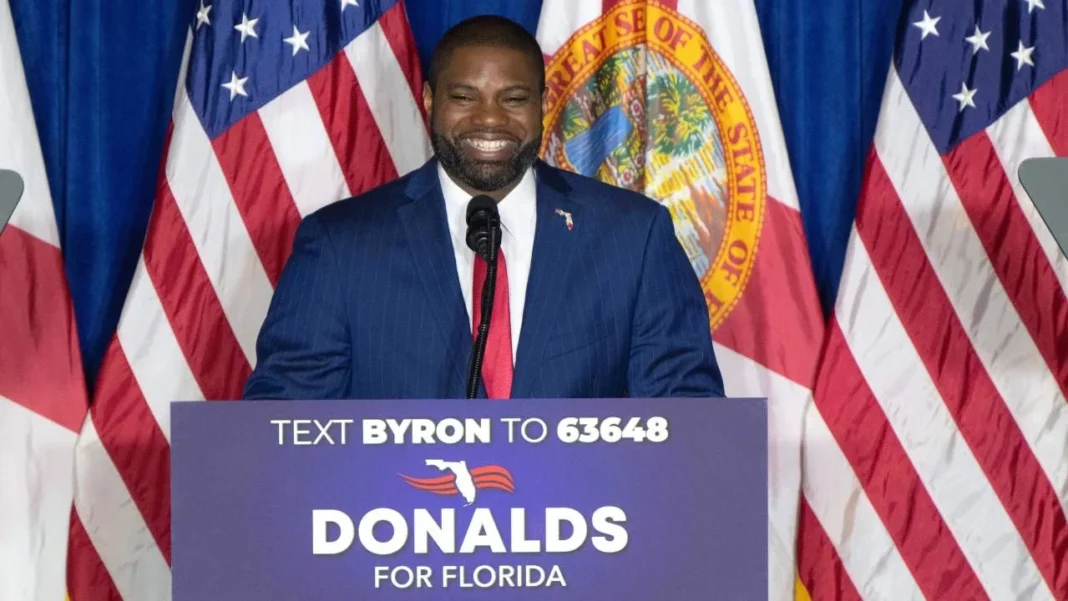

Florida’s race to succeed Gov. Ron DeSantis is beginning to take shape, and U.S. Rep. Byron Donalds appears to be entering the next phase of the campaign with significant momentum.
As the state’s candidate qualifying period concludes and political attention shifts toward fundraising, endorsements, and voter outreach, Donalds has emerged as one of the most recognizable Republican candidates seeking the governor’s mansion in 2026.
The Southwest Florida congressman entered the race with strong support among conservative voters and quickly became one of the most discussed figures in the contest. His profile has continued to rise thanks to his national media presence, ties to the America First movement, and support from prominent Republican leaders.
A High-Profile Republican Candidate
Donalds has spent recent years building a reputation as one of Florida’s most visible conservative voices in Congress. His appearances on national television, advocacy for limited government, and support for President Donald Trump’s agenda have helped him gain attention far beyond his congressional district.
Supporters view Donalds as a candidate capable of continuing many of the policies that helped transform Florida into one of the nation’s most influential Republican-led states.
The governor’s race represents a major opportunity for Donalds to transition from federal office to statewide leadership at a time when Republicans continue to dominate Florida politics.
The Republican Field Continues to Develop
While Donalds has established himself as a leading contender, the Republican primary remains far from settled.
Several potential candidates have generated speculation about entering the race, while others continue building support among grassroots activists, donors, and local party organizations.
As campaigns move beyond the qualifying stage, fundraising reports, endorsements, and organizational strength will become increasingly important indicators of political momentum.
Florida’s Republican electorate has historically rewarded candidates who combine strong conservative credentials with the ability to build broad statewide coalitions, making the months ahead critical for every campaign.
Democrats Face an Uphill Battle
The Democratic Party is also preparing for a highly competitive election cycle, though the political environment remains challenging.
Florida has steadily shifted toward Republicans in recent statewide elections, with GOP candidates posting strong performances among suburban, Hispanic, and working-class voters.
Democratic candidates are expected to focus heavily on affordability, insurance costs, housing, healthcare, and education as they attempt to rebuild support in key regions of the state.
Still, Republicans enter the early stages of the campaign cycle with significant advantages in voter registration, fundraising networks, and statewide infrastructure.
Issues Likely to Define the Race
While personalities and campaign strategy will attract attention, voters are likely to focus on several major policy issues over the coming year.
Property tax reform remains one of the most closely watched debates in Tallahassee following efforts to provide additional relief to homeowners. Insurance affordability, economic growth, government spending, education, public safety, and immigration policy are also expected to play significant roles in the campaign.
Candidates from both parties will spend the coming months attempting to convince voters that they are best positioned to address the issues affecting Florida families and businesses.
Looking Ahead
With qualifying complete and campaigns beginning to shift into full election mode, Florida’s race for governor is poised to become one of the most closely watched contests in the country.
Byron Donalds enters this stage with considerable visibility and growing momentum, but the road to the governor’s mansion remains long.
The months ahead will determine whether early advantages can be transformed into lasting political success as candidates compete to lead the nation’s third-largest state.