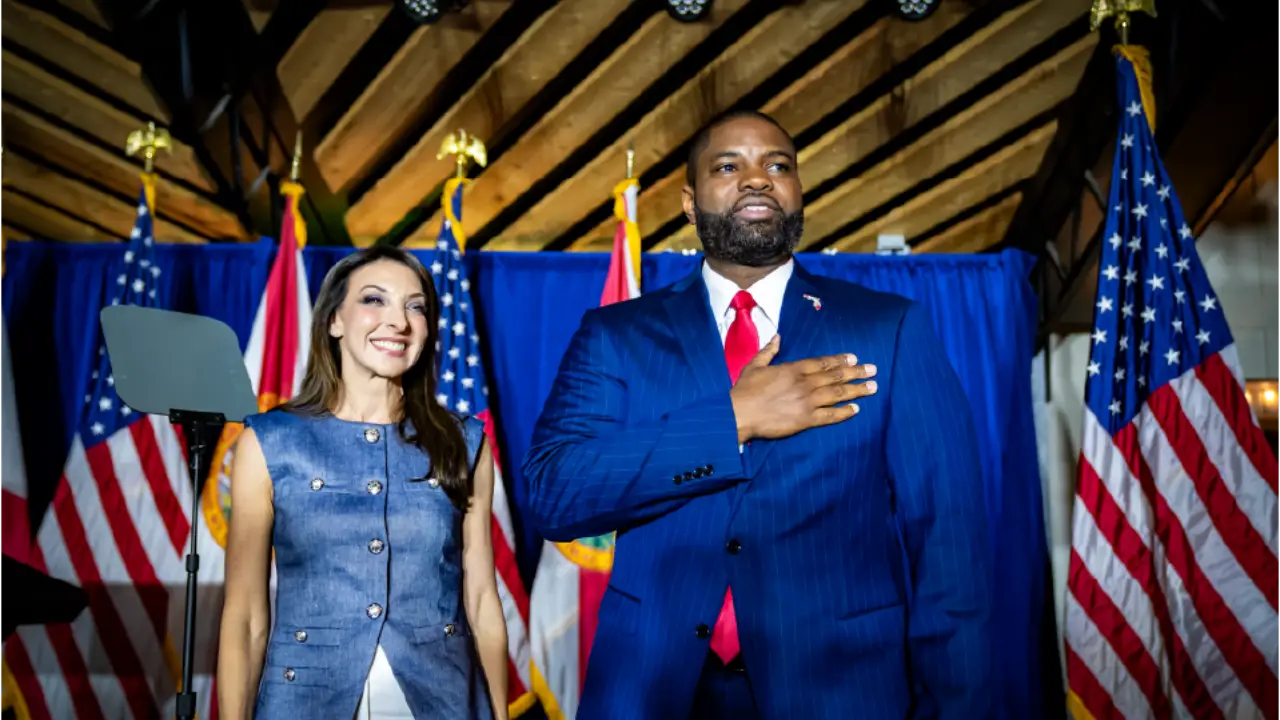
Republican gubernatorial nominee Byron Donalds is facing new scrutiny over parts of his record in the Florida Legislature, including proposals involving public meetings and the threshold for felony theft, as voters begin weighing how the former state lawmaker would govern Florida.
Donalds, now a U.S. congressman, served in the Florida House before winning election to Congress. His Tallahassee record has returned to the spotlight as he campaigns to succeed Gov. Ron DeSantis.
Florida election records show Donalds and running mate Bryan Ávila advanced as the Republican ticket following the August primary, setting up a November general-election contest against Democratic nominee David Jolly and running mate Gwen Graham.
The renewed attention centers in part on two proposals Donalds pursued as a state representative: a 2017 measure affecting Florida’s open-meetings requirements and a 2019 criminal-justice proposal that sought to substantially increase the dollar threshold for felony theft.
Axios reported Wednesday that Donalds did not answer when asked whether he continues to support those earlier positions.
A 2017 challenge to Florida’s open-meetings rules
In 2017, Donalds sponsored HB 843, legislation dealing with meetings between two members of certain public boards and commissions.
The official Florida Legislature record shows the proposal would have exempted meetings between two members of qualifying boards or commissions from some of the requirements of Florida’s public-meetings law, subject to restrictions.
The measure was sponsored by Donalds and Rep. Bob Rommel, with several other lawmakers joining as co-sponsors.
Florida’s Sunshine Law generally requires meetings of public boards or commissions at which official business is discussed to be open to the public.
The proposal generated opposition from government-transparency advocates who warned that allowing two board members to meet privately could weaken Florida’s longstanding open-government protections.
The bill advanced through committees and reached the House floor.
But it ultimately failed.
On May 2, 2017, the Florida House voted 68-48 on the committee substitute — short of what was required for passage of the public-meetings exemption.
The proposal has taken on new relevance because Donalds has emphasized government transparency during his campaign for governor.
The question now confronting the Republican nominee is whether the approach he advocated in 2017 still reflects how he believes Florida’s public-meetings laws should operate.
Donalds did not answer Axios when asked whether he still supports the legislation.
Donalds pushed to raise felony-theft threshold
Two years later, Donalds became a prominent advocate for changing Florida’s theft laws.
In January 2019, he filed HB 589, which proposed increasing the amount of stolen property necessary for certain theft offenses to become felonies.
At the time, Florida’s threshold for third-degree felony grand theft was generally $300.
Donalds’ legislation sought to increase that threshold to $1,000.
The proposal also would have raised thresholds for several other theft and retail-theft offenses.
A Florida House staff analysis shows the legislation would have changed the threshold for third-degree felony grand theft from $300 to $1,000 and similarly increased the threshold for third-degree felony retail theft.
The proposal wasn’t simply a reduction in penalties across the board. It also included provisions addressing repeat offenders, including enhanced penalties under specified circumstances for people with prior theft convictions.
Donalds argued at the time that Florida’s felony threshold had not kept pace with the passage of time.
“The felony-theft threshold has not been moved in our state since 1986,” Donalds told lawmakers during consideration of the proposal.
The House Criminal Justice Subcommittee approved the measure 10-3 in March 2019. It later received a 9-0 favorable vote from the Justice Appropriations Subcommittee and advanced through the Judiciary Committee by a 14-2 vote.
The proposal therefore had substantial support in the Republican-controlled Legislature.
HB 589 itself eventually died on the House calendar, but the Legislature’s official record notes that related provisions were addressed in the broader criminal-justice legislation HB 7125, which became law in 2019.
Criminal justice reform was part of a broader Republican debate
The debate over Florida’s felony-theft threshold was not confined to Donalds.
Republican Sen. Jeff Brandes separately proposed increasing the threshold even further, to $1,500, demonstrating that changing the decades-old limit had support among other Republican lawmakers.
Donalds argued that increasing the threshold was overdue because the $300 figure had remained unchanged for decades.
Supporters also argued that adjusting the threshold could reduce unnecessary incarceration and bring Florida more in line with other states.
A House staff analysis estimated that Donalds’ proposal would significantly decrease the need for prison beds.
Critics, however, raised concerns about the effect higher thresholds could have on retailers, property owners and repeat offenders.
Years later, Donalds’ Republican opponents would use the issue against him politically, portraying his previous support for a higher felony threshold as evidence of a softer approach to crime.
Legislative record meets a 2026 campaign
The significance of Donalds’ Tallahassee record is different now.
As a state representative, Donalds was one of 120 members of the Florida House debating individual pieces of legislation. As governor, he would have the power to sign or veto legislation, shape state agency policy and set priorities for the Legislature.
That makes his previous legislative positions potentially relevant to voters looking for clues about how a Donalds administration might approach public records, criminal justice and government accountability.
But a legislative position taken seven or nine years ago does not necessarily establish what Donalds would do as governor in 2027.
That distinction is important.
There is currently no evidence that Donalds has formally repudiated either his 2017 public-meetings proposal or his support for increasing Florida’s felony-theft threshold. Nor does the absence of a response establish that his views have changed.
Instead, the renewed scrutiny raises a straightforward campaign question:
Does Byron Donalds still support the policies he championed in Tallahassee?
With the 2026 Florida general election approaching, answering that question could provide Florida voters with a clearer picture of how the Republican nominee’s legislative record compares with the agenda he is presenting today.
RELATED COVERAGE
- Byron Donalds Challenges David Jolly to Florida Governor Debates
- Byron Donalds Dismisses Debate Calls in Hialeah Visit
- Ken Griffin Gives $10 Million to Pro-Donalds Committee
- Florida Elections 2026: Governor, Congress and Key Races