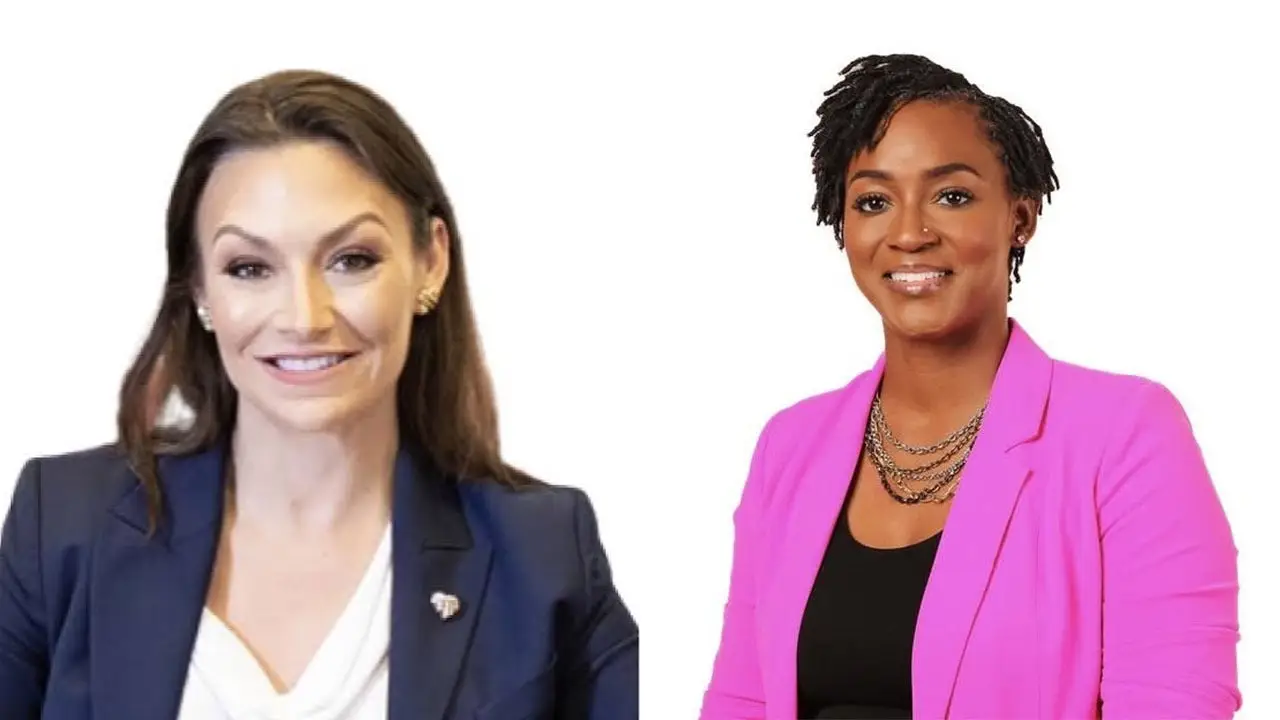
TALLAHASSEE, Fla. — A reported confrontation between Democratic U.S. Senate nominee Angie Nixon and Florida Democratic Party Chair Nikki Fried is exposing tensions inside the party just days after Nixon’s unexpected primary victory.
Nixon defeated Alex Vindman in Tuesday’s Democratic U.S. Senate primary, overcoming a significant fundraising disadvantage to secure the nomination against Republican Sen. Ashley Moody.
Now, attention is shifting from how Nixon won to whether Florida Democrats can unite behind her before November.
Those tensions spilled into the open Friday.
Nixon and Fried clash after primary
Axios reported Friday that Nixon and Fried had a heated telephone conversation following the primary, with Nixon confronting the party chair over what she viewed as a lack of support for her campaign.
According to the report, Fried expressed concerns about the political consequences of Nixon being associated with socialism as Democrats attempt to compete statewide in a state Republicans have increasingly dominated.
Accounts of the conversation differed over who raised their voice and how the confrontation unfolded.
The Florida Democratic Party publicly congratulated Nixon along with gubernatorial nominee David Jolly and other statewide Democratic nominees after the primary.
The reported confrontation contrasts sharply with the party’s public message following Tuesday’s primary.
In an election-night statement, Fried congratulated Nixon on winning the Democratic nomination and said the party’s nominees were stronger when Democrats fought together. The Florida Democratic Party described itself as “united, organized, and ready to win” heading into November.
The reported private exchange between Fried and Nixon days later, however, suggests tensions remained beneath that public show of unity.
Nixon, however, has pushed back against efforts to define her candidacy solely through ideological labels.
Nixon Tested Against Moody Before Primary
Although Nixon entered the Democratic primary as the underdog, polling conducted before the election suggested she could perform about as well as — or slightly better than — Vindman in a general-election matchup against Republican Sen. Ashley Moody.
A University of North Florida Public Opinion Research Lab poll conducted July 8-17 found Moody leading Nixon 50% to 42% among likely Florida midterm voters, an eight-point advantage.
In the same survey, Moody led Vindman 50% to 40%.
The results are notable following Nixon’s upset victory because they complicate arguments that Vindman was necessarily the stronger general-election candidate. The two hypothetical matchups were within the poll’s margin of error relative to one another, and UNF pollster Sean Freeder said at the time that the two Democrats performed similarly despite their different ideological approaches.
The UNF survey included 848 likely Florida midterm voters and had an overall margin of error of plus or minus 3.8 percentage points.
View the full University of North Florida poll.
Socialism becomes central political issue
Nixon’s association with the Democratic Socialists of America has quickly become one of the central issues of the general-election campaign.
Republicans have seized on that affiliation in an effort to portray Nixon as outside Florida’s political mainstream.
But Nixon has distanced herself from portions of the organization’s platform and has rejected attempts to attribute every DSA position to her personally.
PolitiFact reported Friday that Nixon does not support several positions Republicans have sought to associate with her through the DSA, including allowing noncitizens to vote. She has also said she does not support abolishing all prisons, although she supports eliminating for-profit prisons.
The ideological debate could prove particularly significant in South Florida, where socialism has historically been a politically potent issue among voters with roots in Cuba, Venezuela and other Latin American countries.
Democratic leaders in South Florida were already confronting that challenge following Nixon’s victory.
Jolly distances himself on policy
Democratic gubernatorial nominee David Jolly has also made clear that he and Nixon do not agree on every issue.
Jolly, a former Republican congressman who won the Democratic gubernatorial nomination Tuesday, said following the primary that he differs with Nixon on numerous policy questions.
That creates an unusual statewide Democratic ticket heading into November.
Jolly has positioned himself as a centrist alternative to Republican gubernatorial nominee Byron Donalds, while Nixon emerged from a grassroots progressive campaign that defeated a better-funded establishment opponent.
The political question for Democrats is whether those different constituencies can coexist on the same statewide ticket — and whether they can mobilize enough voters to overcome Republicans’ substantial advantage in Florida.
Sanders endorsement adds national attention
While Nixon faces skepticism from some Florida Democrats, she received a major boost from the national progressive movement this week.
Independent Vermont Sen. Bernie Sanders endorsed Nixon following her primary victory, bringing one of the country’s most prominent progressive political figures into the Florida Senate contest.
Sanders said defeating Moody would not be easy but argued that Nixon could build a campaign around working-class voters.
The endorsement adds national attention to a race that already drew headlines because of Nixon’s unexpected defeat of Vindman.
It also reinforces the political contrast Republicans are attempting to establish between Nixon and Moody.
Republicans seize on Nixon victory
Republicans have wasted little time making Nixon a central part of their November messaging.
Moody and other Florida Republicans have highlighted Nixon’s progressive record and DSA affiliation while portraying the Senate election as a choice between conservative governance and the political left.
Moody has also challenged media coverage of Nixon during the Democratic primary and argued that voters did not receive enough scrutiny of her political positions before she defeated Vindman.
The Republican strategy could extend beyond the Senate race.
Nixon’s nomination gives GOP candidates an opportunity to ask Democratic candidates elsewhere on the ballot whether they support their party’s Senate nominee and her policy positions.
That could be particularly significant in competitive South Florida races.
Nixon victory reshapes Florida Democrats
Nixon’s upset was already a significant political setback for Florida’s Democratic establishment.
Vindman entered the primary with national recognition, a substantial fundraising advantage and connections to prominent national Democratic figures.
Nixon instead relied heavily on grassroots organizing and a progressive economic message to win the nomination.
Her victory demonstrated that Democratic primary voters were willing to reject the better-funded candidate — but it also left party leaders confronting a general-election environment dramatically different from the one many had anticipated.
Florida has moved sharply toward Republicans in recent election cycles, and Moody enters the general election with significant structural advantages.
The challenge for Democrats now is no longer simply whether Nixon can compete with Moody.
It is whether the party can unify around Nixon while Republicans work to make her political identity an issue in races across the state.
With less than three months until Election Day, the reported Nixon-Fried confrontation suggests that process may not be seamless.
Florida voters will decide the Senate race on Nov. 3.