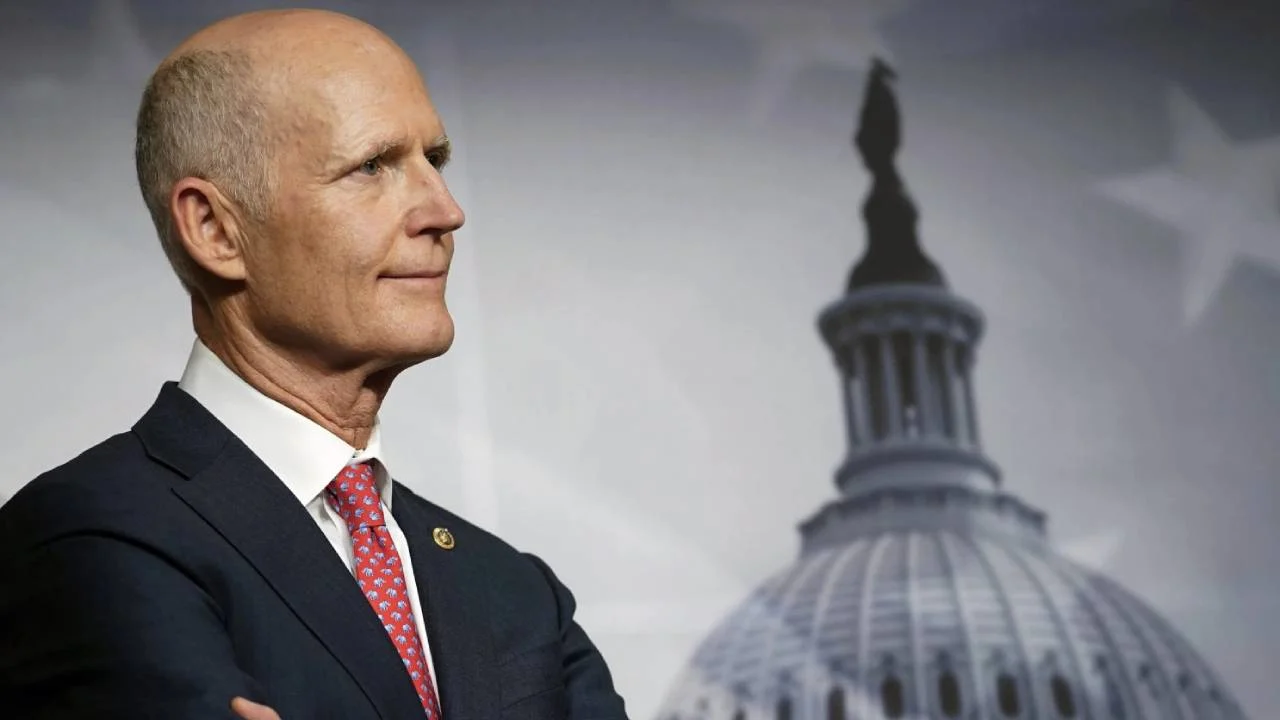
TALLAHASSEE, Fla. — U.S. Sen. Rick Scott said Friday that he supports Florida’s proposed Amendment 3 and intends to vote for it, while warning local governments that they must protect essential services as they absorb billions of dollars in projected property-tax reductions.
Scott’s statement clarified his position after earlier comments about police protection, schools and county budgets prompted questions about whether he had broken with Gov. Ron DeSantis over the proposal.
“I support any tax or fee cut, and I am going to be voting for it,” Scott wrote on X.
The Republican senator said Florida’s rising cost of living makes property-tax relief necessary. At the same time, he argued that counties should identify unnecessary spending instead of reducing public safety or other critical services.
Scott asserted that “every county has waste to cut” and framed the disagreement surrounding Amendment 3 as a debate over how local governments should adjust—not whether taxpayers deserve relief.
Scott’s support comes with a warning
During an earlier interview on the Ryan Gorman Show, Scott urged voters to examine how the amendment would affect their individual counties and cities.
“Our property taxes are too high,” Scott said, according to FOX 13.
He nevertheless raised questions about whether lower property-tax collections could affect police protection and other services. When asked about the possible impact in Collier County, where Scott resides, the senator responded: “Yeah, I’m worried about it, my county.”
Scott also mentioned schools while discussing possible trade-offs. Amendment 3, however, expressly excludes school district taxes from its expanded homestead exemption. Its most direct financial effects would fall on counties, municipalities and other local taxing authorities.
His subsequent statement narrowed the apparent distance between his position and DeSantis’ stance. Both Republicans say they will vote for the amendment, though Scott has emphasized protecting local services while DeSantis has said the proposal falls short of the broader property-tax reform he originally sought.
What Amendment 3 would change
During a June special session, the Florida Legislature approved the joint resolution placing Amendment 3 on the Nov. 3 general election ballot.
- Increase the homestead exemption for non-school property taxes to $150,000 in 2027 and $250,000 beginning in 2028.
- Adjust the expanded exemption for inflation beginning in 2029.
- Require newer Florida residents to wait five years before receiving the expanded exemption.
- Reduce the annual assessment-growth cap on non-homestead property from 10% to 5% for non-school taxes.
- Restrict county and municipal property-tax spending to a specified list of government purposes.
Those permitted purposes include public safety, infrastructure, natural-resource projects, debt payments, employee retirement obligations and government operations.
The amendment must receive at least 60% approval statewide to become part of the Florida Constitution. If adopted, it would take effect Jan. 1, 2027.
Local revenue reductions could reach $11.86 billion
A nonpartisan legislative analysis estimates Amendment 3 would reduce local non-school property-tax revenue by approximately $4.95 billion during the 2027–28 fiscal year.
The projected reduction increases to $8.78 billion the following year, when the $250,000 exemption would take effect. The recurring annual impact is expected to reach approximately $11.86 billion by the 2031–32 fiscal year.
Individual counties have begun publishing their own projections.
Orange County estimates it would collect approximately $165 million less in 2027 and $275 million less in 2028. That includes projected reductions of $46 million for fire services and $30 million for the sheriff’s budget during the first year.
County officials emphasize that no service reductions have been approved. They contend, however, that losses of that magnitude could require decisions involving staffing, infrastructure projects, fees and future investments.
Supporters of the amendment respond that Florida local governments have benefited from years of rising property values and should reduce lower-priority spending before asking taxpayers for additional revenue.
Scott’s position reflects both sides of that argument: homeowners need relief, he says, but local governments must implement the reductions without abandoning essential responsibilities.
Amendment 3 battle intensifies
The senator’s clarification comes as the political campaign surrounding Amendment 3 becomes increasingly active.
The Florida Democratic Party has formally launched a campaign against the amendment, arguing it would jeopardize fire rescue, emergency services, parks, libraries and local infrastructure.
Several opposition organizations have also mobilized while a major organized campaign supporting the amendment has yet to emerge.
The measure also faces legal challenges to its ballot title and summary. Plaintiffs argue the language is misleading and improperly encourages voters to support the proposal. The lawsuit challenges the wording presented to voters, not the Legislature’s authority to propose the amendment.
Scott’s declaration gives supporters another prominent Republican voice in favor of the measure. His warnings, however, also reinforce the central question voters will confront: whether the promised tax relief outweighs the potential effects on local government revenue.
For Scott, the answer is to approve the tax reduction and require local officials to make it work without sacrificing the services residents depend upon.
Related Coverage
- Florida Democrats Launch Campaign Against Property Tax Amendment, Call Proposal a ‘Scam’
- Amendment 3 Opposition Grows as Property Tax Measure Lacks Organized ‘Yes’ Campaign
- Judge to Decide Whether Florida Property Tax Amendment Language Misleads Voters
- Florida Elections 2026: Candidates, Ballot Measures and Voter Guide
Sources
- Rick Scott statement on Amendment 3
- Florida House — CS/HJR 1F and final legislative analysis
- Florida Senate — CS/HJR 1F
- Orange County Amendment 3 fiscal estimates
- FOX 13 interview coverage
Explore More Florida Politics
- New Poll Shows Ashley Moody Leading Florida Senate Race
- DeSantis Calls for Quick Court Ruling on Property Tax Amendment
- DOME Briefing: Donalds Maintains Poll Lead as Jobless Claims Rise and Amendment 3 Opposition Grows