
TALLAHASSEE, Fla. — A newly released state audit found that the Florida PACE Funding Agency failed to prevent 148 residential financing agreements totaling $3.7 million from being executed in Orange County even though the county had not authorized the agency’s program.
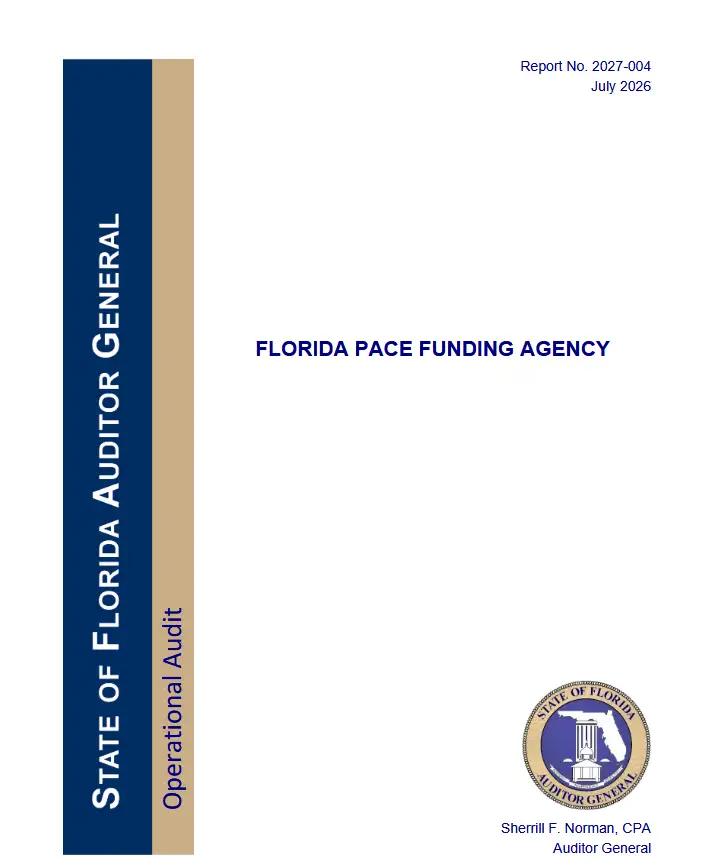
The Florida Auditor General’s operational audit, issued July 22, also questioned a $100,767 advance payment to a former executive director, identified weaknesses in homeowner disclosures and underwriting, and raised concerns about debit-card and travel controls.
The report contains nine findings involving the Florida PACE Funding Agency, an independent special district created through an interlocal agreement between Flagler County and the City of Kissimmee.
PACE—Property Assessed Clean Energy—programs finance improvements such as roofs, impact-resistant windows, air-conditioning systems and storm-resiliency projects. Property owners repay the financing through annual non-ad valorem assessments added to their property-tax bills.
Those assessments are not conventional property taxes or government grants. They can create liens against participating properties, making the program’s underwriting, disclosure and local-authorization requirements significant consumer protections.
Auditor finds 148 Orange County agreements lacked authorization
Florida law permits a PACE administrator to offer financing only in counties and municipalities that formally authorize the program through an ordinance or resolution.
Auditors initially found six agreements totaling $84,457 that Home Run Financing, a third-party administrator working for the agency, executed for Orange County properties in August and September 2024.
Home Run personnel told auditors that the company’s application system had incorrectly listed Orange County as an authorized jurisdiction. According to the report, the company discovered the error in mid-October 2024 and believed it had stopped entering new agreements there.
Auditors expanded their review and identified 142 additional Orange County agreements, bringing the total to 148 agreements worth approximately $3.7 million.
Nine of those agreements, totaling approximately $286,000, were executed from November 2024 through January 2025—after Home Run reportedly discovered the problem and said it had stopped accepting Orange County agreements.
Home Run told auditors that projects were already underway when it identified the error and that canceling the agreements would have been unfair to homeowners and contractors.
The agency said it had policies intended to prevent third-party administrators from operating in jurisdictions that had not approved its program. The Auditor General responded that agency records did not demonstrate that those policies had been put in writing.
The audit does not establish whether the 148 assessments remain active, whether they continue to appear on Orange County property-tax bills or whether affected homeowners could receive restitution or other relief.
Homeowner underwriting and disclosures questioned
The Orange County finding was part of a broader review of 1,849 residential PACE agreements totaling approximately $52.7 million that were executed from July 2024 through February 2025.
Auditors examined a sample of 60 agreements totaling approximately $1.64 million. The report identified 157 underwriting deficiencies across that sample, although the audit cautioned that its testing was not intended to statistically project the findings across every agreement.
Among the findings:
- Eighteen agreements totaling $754,242 received 30-year financing terms even though auditors concluded that a 20-year statutory limit applied.
- Thirty agreements totaling $713,395 lacked documentation showing that administrators verified whether the properties had existing or unrecorded qualifying improvements.
- One agreement carried an annual assessment that exceeded 10% of the owner’s annual household income by approximately $600.
- Some files did not demonstrate that required zoning, lien and property-tax checks occurred before contractors received authorization to begin work.
- Required written disclosures were not always supplied or individually acknowledged before contractors received notices to proceed.
The audit said the disclosure requirements are intended to ensure homeowners understand the financing amount, interest, annual assessment, lien implications and consequences of failing to pay.
Under Florida’s residential PACE law, failure to pay an assessment can result in penalties, legal costs and a tax certificate that could place the property at risk.
Auditors question $100,767 advance payment
The audit separately examined a transition-services agreement with former Executive Director Michael Moran, who served through Dec. 31, 2024.
Moran and the agency entered into an employment-termination and transition-services agreement covering Jan. 1 through June 30, 2025. The agreement provided $100,767 for advice, support, government relations and other transition assistance.
Auditors found that the contract did not contain measurable deliverables, written performance standards or a mechanism for monitoring the services.
Moran submitted an invoice Jan. 3, and the agency paid the entire $100,767 on Jan. 13—more than five months before the service period ended.
The Auditor General said agency officials did not provide records demonstrating what services Moran performed under the agreement. The report characterized the advance payment as potentially violating the Florida Constitution’s prohibition against a government entity extending public credit for private benefit.
That is an audit finding, not a court judgment or criminal determination.
Auditors also concluded that employment agreements for Moran and current Executive Director Wendi Leach allowed as much as 52 weeks of severance pay, exceeding what the report described as a 20-week limit under state law.
Agency counsel argued that the restriction did not apply because the agency’s salaries came from program fees rather than tax revenue or state appropriations. The Auditor General rejected that interpretation and recommended that the board amend the current contract.
Audit also identifies spending-control problems
Other findings involved agency purchasing and travel practices.
Auditors examined 30 debit-card transactions totaling approximately $24,000 and found incomplete documentation, insufficient independent approval and other weaknesses in agency controls.
A separate review of travel expenses identified a $309 airline seat upgrade, 13 meal expenses totaling $4,829 that exceeded state subsistence limits and $695 in sales taxes paid on hotel expenses despite the agency’s tax-exempt status.
The agency disputed several of the audit’s legal, procedural and factual conclusions, including the scope of the review and the application of certain state laws to an independent special district.
The Auditor General said its office had the authority to examine the records, had given management sufficient time to respond and had revised two preliminary findings after reviewing additional documents supplied by the agency. The final report retained all nine findings.
What happens next
The Auditor General recommended that the agency:
- Establish written controls preventing PACE activity in jurisdictions that have not authorized the program.
- Strengthen underwriting and disclosure procedures before contractors begin work.
- Amend agreements to comply with statutory requirements.
- Cap executive severance provisions at 20 weeks.
- Stop paying service contracts in advance.
- Improve board oversight of debit-card and travel expenses.
Florida law now requires the Auditor General to examine each PACE program administrator at least once every three years. The Florida PACE Funding Agency was the first administrator reviewed under that requirement.
The immediate accountability questions are whether the agency has implemented the recommendations, what will happen to the Orange County assessments and whether the board will seek additional documentation or repayment connected to the $100,767 agreement.
Why It Matters
PACE assessments can help homeowners finance expensive storm-resiliency and energy improvements, but the debt is collected through property-tax bills and can become a lien against the home.
That makes local authorization, accurate underwriting and complete disclosure more than technical paperwork. They are safeguards intended to ensure homeowners understand the cost and legal consequences before work begins.
PACE assessments are separate from the ad valorem property taxes at the center of Florida’s Amendment 3 debate, but both issues demonstrate how decisions involving property-tax bills can directly affect homeowners and local governments.
Related Coverage
- Florida FOP Opposes Amendment 3 Over Public-Safety Funding
- Blaise Ingoglia Says Palm Beach County Could Cut Property Taxes
- Property Tax Amendment Could Become Florida’s Biggest Election Issue
- DOME Weekend: Florida’s Latest Political and Government Developments
Sources
- Florida Auditor General Report 2027-004
- Auditor General official report listing
- Florida Statutes §163.081—Residential PACE programs
- Florida Statutes §163.087—PACE reporting and audits