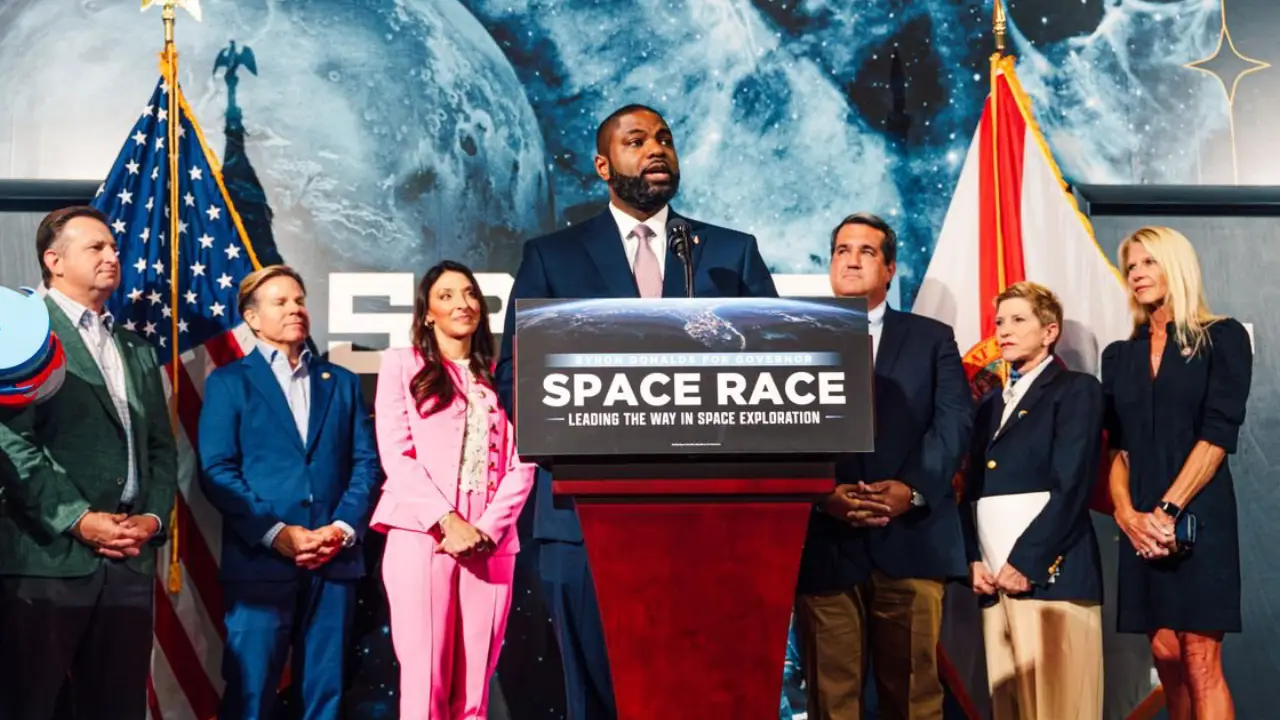
TALLAHASSEE, Fla. — Republican gubernatorial candidate Byron Donalds unveiled a wide-ranging “Space Race” policy plan Thursday aimed at expanding Florida’s aerospace industry through faster permitting, workforce training and closer coordination between state government and commercial space companies.
Donalds, who has maintained a substantial lead in Florida’s Republican gubernatorial primary, said he wants to make Florida “the world’s headquarters for space exploration” while creating more pathways for Floridians without advanced science degrees to enter the industry.
“Florida is going to lead, and we are going to take the next giant leap right here in the Sunshine State,” Donalds said while announcing the proposal.
The plan arrives less than three weeks before Florida’s Aug. 18 primary and expands the policy platform of a candidate who also holds a commanding campaign-finance advantage over his Republican opponents.
Faster permits and new development sites
Donalds said his administration would identify 10 areas of Florida as strategic development sites for space manufacturing and accelerate state permitting for companies seeking to build facilities there.
He also proposed establishing an Office for Space Industry within the Governor’s Office and convening a Space Race Summit during his first year in office to recruit aerospace companies and investors.
The campaign did not identify the proposed development sites or provide details about the permitting changes, potential incentives or environmental-review requirements that would accompany the initiative.
Some portions of the plan could be pursued administratively, while others would likely require funding or statutory changes approved by the Florida Legislature.
Aerospace training beyond scientists and engineers
Workforce development is another major component of the proposal.
Donalds called for “zero-tuition” training programs developed with commercial aerospace companies. The programs would prepare workers for jobs including welding, machining, construction and advanced manufacturing.
Florida already operates a Space Florida Academy Program through dozens of participating school districts. The initiative connects students with industry-recognized credentials in aerospace, construction, cybersecurity, logistics, semiconductors and advanced manufacturing.
Donalds said the existing academy would play a central role in his plan by the second year of his administration.
The campaign has not released a projected cost, funding source or eligibility requirements for the proposed tuition-free programs.
Donalds renews push to relocate NASA headquarters
The proposal also calls for relocating NASA headquarters from Washington to Florida and expanding U.S. Space Force training in the state.
A Florida governor could advocate for those changes but could not order either action. Moving NASA headquarters or directing Space Force training would require decisions by Congress and the federal executive branch.
Donalds introduced the CAPE Canaveral Act in March 2025 to move NASA headquarters to Brevard County within one year of the bill becoming law.
The legislation attracted 16 Republican and Democratic co-sponsors from Florida’s congressional delegation. However, it remains at the introduced stage and has not advanced beyond referral to the House Science, Space and Technology Committee.
Florida launch figures differ from documented totals
Donalds also cited Florida’s launch activity as evidence of the industry’s growth, saying 165 rockets were launched from the state during 2025 and predicting Florida could eventually host more than 1,000 launches annually.
Available launch records do not support those figures.
Florida’s Space Coast—consisting of Kennedy Space Center and Cape Canaveral Space Force Station—recorded approximately 109 launches in 2025. The figure of 165 appears to correspond with SpaceX’s nationwide orbital launches from Florida and California that year, not launches originating exclusively in Florida.
A Suncoast Searchlight fact check previously examined similar statements by Donalds and found that regional planning projections anticipate approximately 300 annual Space Coast launches by 2035, far below 1,000.
Donalds did not identify the source of his 1,000-launch projection.
Florida nevertheless remains the country’s leading launch location. The Space Coast recorded 93 launches in 2024 before surpassing 100 for the first time in 2025, with SpaceX accounting for most of the activity.
Growing global industry
The World Economic Forum and McKinsey & Company project that the global space economy could grow from approximately $630 billion in 2023 to $1.8 trillion by 2035.
Donalds argued that Florida should capture a larger share of that growth through manufacturing, workforce development and commercial investment.
“Florida launched the first space race, and Florida will win the next one,” Donalds said.
The proposal places aerospace development alongside affordability, infrastructure and economic growth as Donalds campaigns to succeed term-limited Gov. Ron DeSantis.
Donalds faces Lt. Gov. Jay Collins, former House Speaker Paul Renner and businessman James Fishback in the Republican primary. Florida voters can find candidate information and election deadlines through The Florida Pundit’s Florida Elections 2026 guide.
Related Coverage
- New Poll Shows Byron Donalds Maintaining Commanding Lead in GOP Governor’s Race
- Ken Griffin Gives $10 Million to Pro-Donalds Committee
- Byron Donalds Rejects Republican Primary Debate Demands
- Florida Elections 2026: Candidates, Races and Voting Deadlines
Sources
- Byron Donalds — “Space Race” announcement
- Congress.gov — CAPE Canaveral Act
- Space Florida Academy Program
- Suncoast Searchlight — Florida launch projection fact check
- McKinsey and World Economic Forum — Global space-economy projection