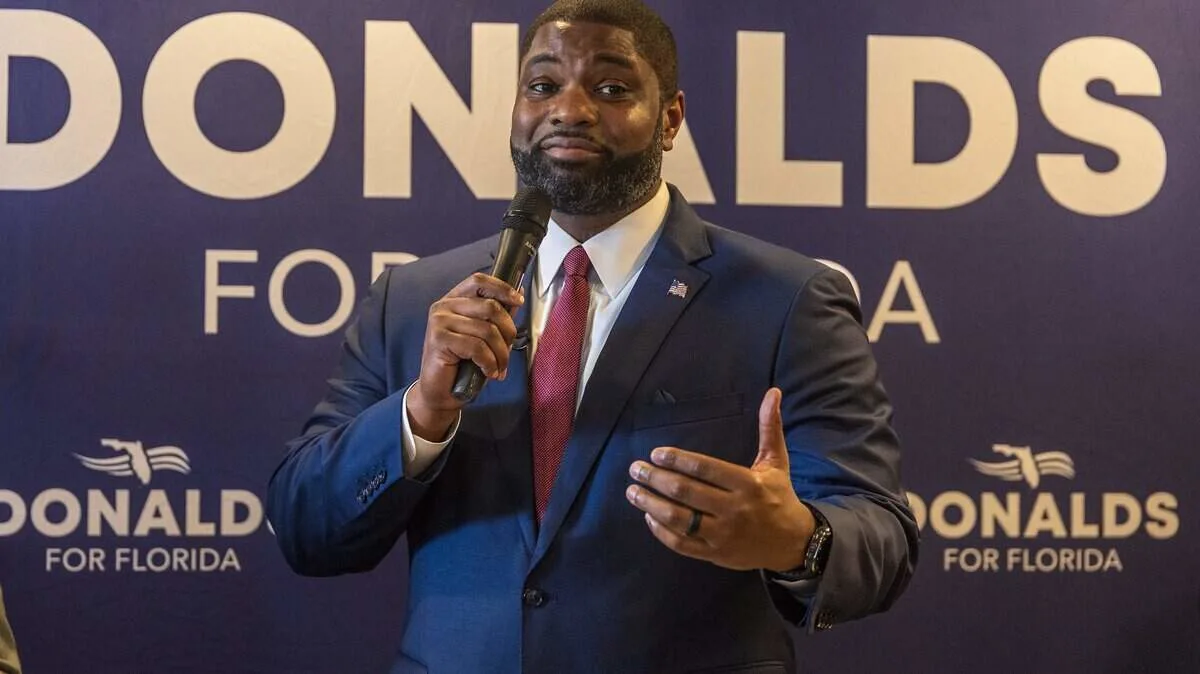
With less than six weeks before Florida Republicans choose their nominee for governor, U.S. Rep. Byron Donalds continues to hold a commanding advantage over a crowded field of Republican challengers, according to multiple public polls. Backed by President Donald Trump’s endorsement and a well-funded campaign, Donalds has remained the clear frontrunner as rivals struggle to gain traction ahead of the Aug. 18 primary.
Despite a crowded Republican field that includes Lt. Gov. Jay Collins, former House Speaker Paul Renner, businessman James Fishback, and several lesser-known candidates, Donalds has consistently maintained a commanding lead in public polling, while no rival has emerged as a clear alternative.
Florida’s 2026 gubernatorial race features one of the largest candidate fields in recent memory, but the contest has remained relatively subdued. Political observers have pointed to Donalds’ sustained polling advantage as a major reason the Republican primary has generated less competition than many expected.
Trump Endorsement Changed the Race
Donalds received an early boost when President Donald Trump endorsed his campaign, helping solidify support among Republican primary voters long before most of the field fully organized.
Since then, multiple statewide polls have placed Donalds well ahead of his Republican opponents. An April Emerson College Poll found Donalds with 46% support among likely Republican primary voters, while an Associated Industries of Florida survey conducted in June showed his lead expanding significantly over the rest of the field.
Those numbers have reinforced the perception that Donalds enters the final weeks of the campaign with a substantial advantage.
Challengers Search for an Opening
While Collins, Renner, and Fishback have each attempted to distinguish themselves through campaign appearances, interviews, and policy proposals, none has significantly narrowed the gap.
The recent lawsuit challenging Fishback’s eligibility to appear on Florida’s gubernatorial ballot has drawn statewide attention, but the legal dispute has largely shifted focus toward residency requirements rather than altering the overall dynamics of the Republican primary.
Meanwhile, neither the Republican Party of Florida nor the Florida Democratic Party plans to host an official gubernatorial debate before the primary election. Instead, several Republican candidates recently participated in an online debate hosted by conservative commentator Patrick Bet-David. Donalds did not participate.
A Race Defined by Organization
Political analysts have noted that Donalds’ position did not develop overnight.
After serving in the Florida House of Representatives and later representing Southwest Florida in Congress, Donalds spent years building statewide name recognition among Republican voters. Combined with Trump’s endorsement and an established fundraising network, that preparation has translated into a campaign widely viewed as the frontrunner entering the final stretch.
Democrats Prepare for the General Election
While much of the political attention has focused on the crowded Republican primary, Democrats are also campaigning to win back the Governor’s Mansion after two terms under Gov. Ron DeSantis. Former Republican Congressman David Jolly, now running as a Democrat, is among the leading candidates seeking his party’s nomination, though the Republican contest has dominated statewide political coverage because of its size, high-profile candidates, and the GOP’s voter registration advantage in Florida.
What Comes Next
Although Donalds remains the clear frontrunner, the race for the Republican nomination is far from over.
With the Aug. 18 primary approaching, candidates will spend the coming weeks traveling the state, raising campaign funds, earning endorsements, and making their case to Republican voters. The July 21 court hearing over James Fishback’s eligibility could also influence the final stretch of the campaign, even if it does not significantly alter Donalds’ standing in public polls.
For now, Donalds enters the final weeks of the primary with a substantial advantage built on strong polling, President Donald Trump’s endorsement, and an established statewide campaign organization. His opponents, however, still have a limited window to reshape the race before early voting begins and Republican voters choose their nominee to succeed Gov. Ron DeSantis.
Sources
- Axios reporting on the 2026 Florida governor’s race.
- Associated Industries of Florida Center for Political Strategy statewide poll.
- Emerson College Polling Florida Governor Survey.